
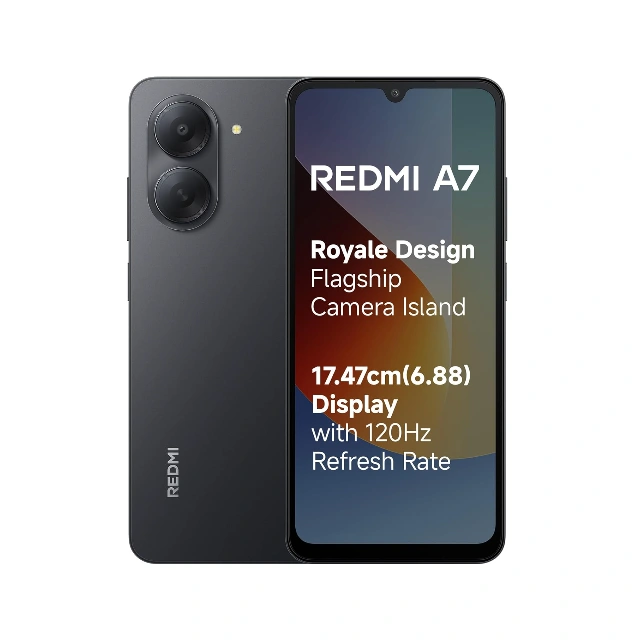
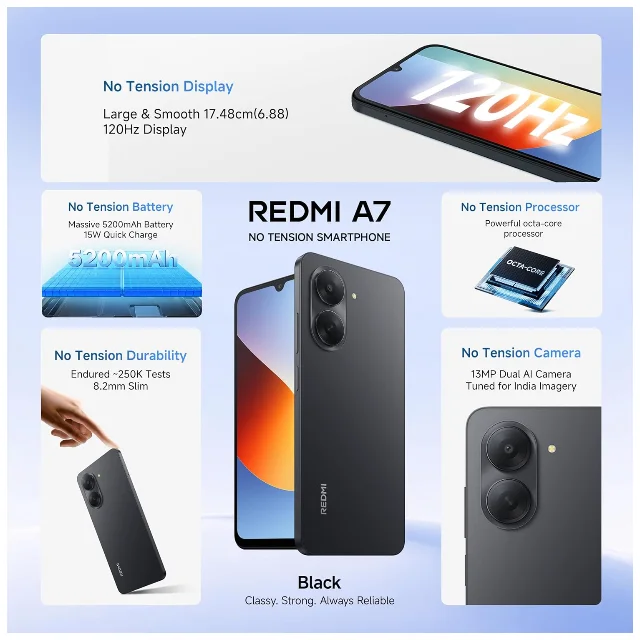
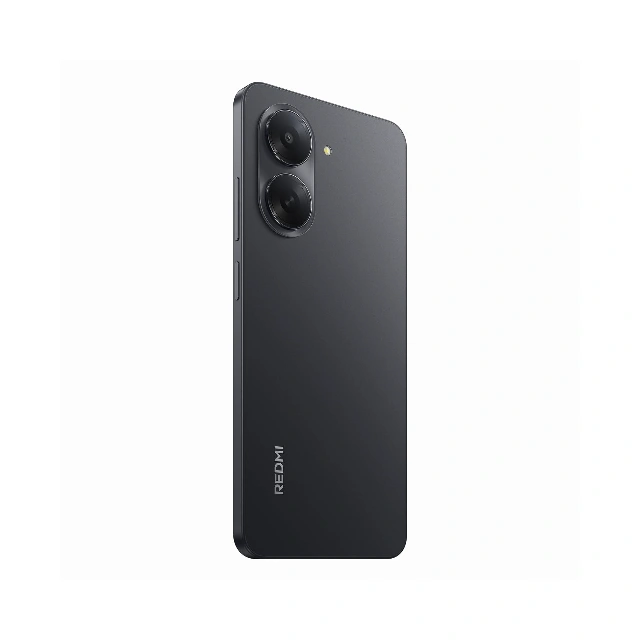
The Xiaomi Redmi A7 4G is an entry-level smartphone designed for everyday users who need a large display, reliable battery life and essential smartphone features. It features a 6.88-inch LCD display with a 120Hz adaptive refresh rate, 240Hz touch sampling rate and 1640 x 720 pixel resolution. The display also offers up to 800 nits peak brightness and uses a water-drop notch design.
The smartphone is powered by the Unisoc T7250 chipset with a 1.8GHz octa-core processor. It comes with 3GB LPDDR4X RAM and supports up to 3GB additional virtual RAM. The device includes 64GB internal storage and supports expandable storage up to 2TB through a memory card.
For photography, the Redmi A7 4G features a 13MP rear camera with autofocus and LED flash. Camera features include HDR, Portrait, Timer, Watermark, Night Mode, Time Lapse, Audio Shutter and Palm Shutter. The device also includes an 8MP front camera for selfies and video calls. Both cameras support 1080p video recording at 30fps.
The Redmi A7 4G runs on Android 15 and supports Dual SIM, 4G and VoLTE connectivity. Other connectivity features include dual-band Wi-Fi, Bluetooth 5.2 and USB-C 2.0.
A 5200mAh Li-Po battery powers the device with support for 15W fast charging. Additional features include a side-mounted fingerprint sensor, face unlock, FM Radio with FM Recording and IP52 water and dust resistance.
The Xiaomi Redmi A7 4G is designed as a practical entry-level smartphone for users who prioritize a large display, good battery capacity and basic everyday functionality over flagship-level performance. The combination of a 6.88-inch display and 120Hz adaptive refresh rate is a notable feature in this segment, helping the interface and scrolling feel smoother during social media browsing, web browsing and general navigation. The large screen is also suitable for watching videos and reading content. However, the 1640 x 720 pixel resolution and approximately 262 PPI pixel density mean that the display will not offer the same level of sharpness as Full HD+ smartphones.
Performance is handled by the Unisoc T7250 chipset paired with 3GB LPDDR4X RAM and 64GB storage. This combination is suitable for essential tasks including calls, messaging, social media, browsing, online video streaming and basic applications. Users can also benefit from up to 3GB of virtual RAM, although the physical 3GB RAM remains a limitation for heavy multitasking. Demanding games and resource-intensive applications may experience slower performance. The option to expand storage up to 2TB is useful for users who need additional space for photos, videos and files.
The camera setup is focused on everyday photography rather than advanced imaging. The 13MP rear camera supports autofocus and features such as HDR, Portrait Mode and Night Mode, while the 8MP front camera handles selfies and video calls. Both cameras support 1080p video recording at 30fps. This setup should be sufficient for casual photography and social media but is not designed for users who require advanced camera sensors, ultra-wide photography or high-resolution video recording.
Battery capacity is one of the phone's stronger features. The 5200mAh Li-Po battery should provide dependable battery life for normal daily usage, especially considering the entry-level hardware. However, the 15W charging speed is relatively modest and users may need to spend more time charging the device compared with phones offering faster charging.
Additional features such as the side-mounted fingerprint sensor, face unlock, FM Radio with FM Recording, dual-band Wi-Fi and IP52 protection make the Redmi A7 4G a practical device for budget-conscious users. However, buyers should consider that the device does not support 5G and is limited by its 3GB RAM and entry-level processor.
Overall, the Xiaomi Redmi A7 4G is best suited for first-time smartphone users, students, senior users and people looking for a basic secondary smartphone. Its large 120Hz display, expandable storage and 5200mAh battery are important advantages, while users looking for heavy gaming performance, advanced cameras, fast charging or 5G connectivity should consider a higher-end smartphone.